...is a refuge in this complicated networked world.
A safe place to stumble and explore conversations about integrated marketing communications, social media and international sport.
In the mid 90's I was waiting with Mum, Dad and Jo (my sister-in-law) for my brother, Darren, to emerge from the dressing rooms. It was footy season, and a leisurely wait in the cold outside the members entrance at the Sydney Football Stadium was pretty much our routine.
It was during one of these 'wait' sessions, I first met the remarkable John.
I was used to meeting 'famous' people - especially during footy season - but John was different. He was exceptional.
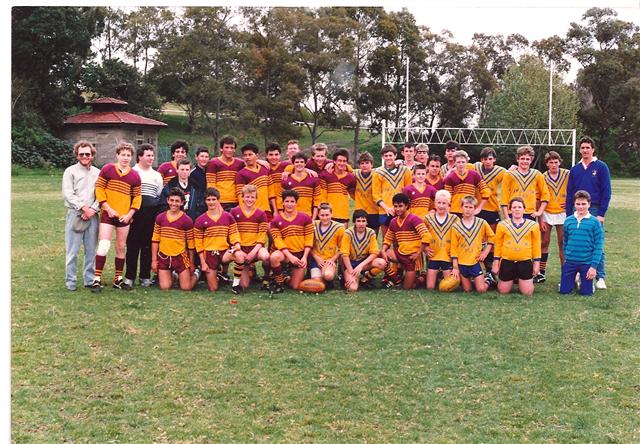
John is standing in the back row 10th from the left
John was my age and as Jo was speaking with him about all things medical, Daz (now emerged from the dressing sheds with a new bout of cuts and bruises) was giving my parents and I the quick run down on avid football-fan and one-time rising star John (as you do!) just prior to the formal introductions.
Now Dad and Darren are born statesmen and so meeting John for the first time was no exception - for Dad. For me, it was a whole other story! Anyway... Dad being Dad (known for his solid handshake), put his hand out in greeting to John (Hadn't Dad been listening during Daz's 10 second de-brief?)
Not surprisingly, John smiled up at him, "I'm sorry Mr Junee, I can't."
I didn't understand what John meant, but without missing a beat, Dad stepped forward and patted him gently on the back with a 'Nice to meet you Johnnie' (another one of Dad's things).
It was then I learnt the significance and social ability of touch.
Taking Dad's lead, I too stepped forward when it was my turn to be introduced and touched John on the shoulder. However, I literally sent him into spasm! Not the response I was expecting, although it did prove a great ice-breaker...
Not knowing what I'd done or what I was supposed to do, I did what I do best: straight shooting. I asked John straight up what had just happened. After a moment, when he'd caught his breath, he laughed and explained he sometimes had spasms - it was just something that happened, ever since his accident.
You see John didn't have the facility to engage in a handshake (which is why Dad touched him on the shoulder); he still doesn't. John became what is called an incomplete quadriplegic after a head clash during a football match at the tender age of 15. Although, he does have the sensation of touch (so Dad must have been listening afterall!) and the spasms are what he calls the powercord effect of his disconnected nerves.
However, 21 years on from his accident, still wheelchair-bound and in need of 24/7 care, is not going to stop John 'walking'(okay rolling) his way from Brisbane to Sydney next year to raise money for the people at Youngcare with his girlfriend Theresa and best mate Paul.
JT has been a statistician for his beloved Wests Tigers since 1993
Why? Because John knows first hand the importance of the work done by Youngcare in their efforts to facilitate independent living for young people living with disability.
John is sharing a little more of his story - not always an easy thing, even for one as open as John - in order to promote the work of Youngcare who are kicking off their fund-raising long weekend with the inaugural Thong Day tomorrow (1 October).
So what is Thong Day? I hear you say... Well I'm glad you asked.
Tomorrow is Youngcare Thong Day, so click the link, find out how you can donate and get involved because access to 24/7 care for those who need it to survive should be a right, not a privilege.
Disability is not discriminating, it can happen to anyone at any time. So whenever you get the opportunity to improve the quality of life of someone living with disability, grab it with both hands, for no other reason, than you still can.
Chatting with JT about living with disability and the
National Disability Insurance Scheme earlier this year
Jacques Derrida claims that the process of writing is fundamentally changed by the way we write. Marshall McLuhan on the other hand points to the medium as 'the message', while German sociologist Niklas Luhmann opines 'man is not able to communicate; only communication is able to communicate'. Three different men, three different opinions. Nothing new about that. Or is there?
Academics define, debate and redefine modern society as it is, or how we as individuals interact with it continuously. Put into a 2010 context, does technology impact the content, delivery or consumption of content and if so how?
How has the process of knowledge production changed with the advent of social media? More specifically, what are the epistemic consequences of social software and information architecture?
Social software enables group interaction. A conduit to conversation. So information architecture must be the mechanics of delivery, yes? Well kind of...
Okay, so accepting the structure of things has changed, how have our conversations changed specifically? And by that I mean, how has our production of knowledge evolved?
From blackboards in lecture halls to death by powerpoint in the boardroom (or classroom!) to Skyping across timezones, the physical space and time of our conversations has evolved through and because of social media capability.
Blogs (just like this one!) and the rise of Wiki's sees the distribution of information and access to knowledge evolved both the classification of information (Luhmann), the way we engage with it and the dissemination process of information as knowledge beyond our local sphere.
McLuhan, Foucault and friends are a lot more accessible via youtube.com, wikipedia and the likes for the academic in training. And we know that what we see and read we need to take with a grain of salt (production and knowledge values are not expert) however, the entree to access is invaluable.
Schiltz, Truyen and Coppens(2007) in their article, Cutting the trees of knowledge: Social Software, Information Architecture and their epistemic consequences discuss how the nature of what is known seems to be changing. They use the example of a Linux expert and the expectations around what that in fact means. No longer is it assumed that the 'expert' contains all knowledge personally ('in his head'), although it is assumed that s/he has direct access to it, either via a social/ professional network or both.
Social networking systems and applications are changing the way we gather, store, disseminate and create knowledge. Aggregated suites of software such as Facebook.com and myspace.com are pervasive.
Why is it important in our production of knowledge again?
The fundamental shift in communications practices is inter-related to the social network of the modern-day information society for which one way or another we can (and do! - Australian's are some of the largest consumers of social media in the world) democratically ENGAGE.
No matter who I am speaking with, everyone wants to know about social media and how to best use it for their business.
The most frightening thing for me is the inflexibility from business owners and senior management teams. Used to throwing money at marketing and sales activities, this group of learned corporates expect this new media channel to fit within the existing consumer consumption paradigm. But it doesn't.
Now, I could lie to any corporate waving a cheque in my direction and tell them that social media is where they need to be and that I can brand them up to Koo-ee... if I was that way inclined, but I'm not.
Quite possibly to my fiscal detriment I tell them THEY need to shift current practices, THEY need to engage personally, because social media is tactile and it's about THEM. And in doing so, they need to be ready for anything. But very few are ready to hear the truth of best practice in social media.
The most common reaction I get is the age-old blank, silent 'you have no idea what you're talking about, I can't possibly do that' look of horror. They're the ones you can't help - yet. But rest assured, they'll come knocking in about 6 - 12 months (maybe less) wanting to take the plunge and for you to hold their hand. That's a good thing, they've had the critical shift in mindset: from observation to a considered willingness moving towards participation.
It's hard to remember sometimes that nearly half of the Australian population do not know life without a mobile telephone...so for them, social media is about as strenuous a jump now, as what Atari to VCR was in the 80's.
Mobile telephony and consumer communications are ubiquitous. What was once achieved with a full-page ad in the sunday papers, now needs to be re-purposed for iPad, iPhone, Blackberry just to ensure the target consumers have the chance (not guaranteed distribution) of engaging with your diligently crafted creative. Then in order to get positive Word Of Mouth (which SM does not guarantee), you need to Tweet, facebook, myspace, blog, retweet and Digg, in the interests of starting (or hopefully continuing) the desired brand and business conversation.
Marketing and Communications practices need to change in order to maximise the potential of new media technologies. It's a bit like driving a car with stability control switched off because you already know how to drive; or outsourcing your call centre without conducting product training or considering systems management processes. It just kind of exists without adding tangible and measurable value intrinsically to your brand and your business.
Ceding control is confronting. It's against every marketing and sales principle worth engaging. That was of course, until the arrival of social media capability.
Knowing if, when and how to cede control is the key to getting cut through within the savvy new media consumer sphere.
So is Social Media hype or part of a Communications Revolution? Neither, merely part of the evolution of 21st century communications.
A former colleague of mine sent me this clip today. It's from the UN Climate conference in Rio in 1992, yet it's message still resonates today.
How far have we come really? How much of what she raises remains a concern in the present day?
We place ourselves at the top of the food-chain. I guess that's our inherent arrogance, afterall, what other animal destroys the natural environment on which it depends for survival?
And how efficient or effective are the pyramids of power, western-style democracies have created in institutions such as the United Nations and World Bank?
Let's be honest, if they were a .dot com in the 90s they both would have been long gone.
To view spaces like Foucault, write like McLuhan, engage audiences like Shirky with the earning potential of Zuckerberg... now that's my idea of best practice.
In over a decade of corporate living, looking back through the eyes of academic inquiry, only now do I see the simplicity of the modern corporate structure embedded with the obstacles of the professional paradigm.
'I'm a marketer' according to my bio. It was only recently that I added 'wanna-be candlestick maker'. Why? Because, it's irrelevant. In modern social spaces, human beings (IMHO) place too much emphasis on labels.
What's the point of title? Social structure.
The foundation of empire is heirarchy. Social and economic divides defined by title, reinforced in cultural practice and focused on the control of the masses.
What are media empires? Economic structures, defined by business practices responsible for the control/ audit of social information, consumed by the masses.
So what does that make professional sport...?
...A social heirarchy, defined by economic divides, reinforced by cultural practices and processes, refined by acceptable business practices and controls while being consumed by choice by the masses.
Since removing her swimming cap to reveal a 'marketable face' and winning three gold medals at the 2008 Beijing Olympics, Stephanie Rice has been the golden girl of Australian swimming. Her success in the pool launching her (willingly or not) into the stratosphere of the modern Australian sporting icon.
A proven performer, Rice has a legion of fans globally. So not surprisingly, opportunistic sponsors came calling and a young lady used to going without (let's be honest, the revenues of the pool are miniscule for most) no doubt thought all her Christmas' had come at once in the form of car-maker Jaguar and intimates apparel retailer Davenport.
Forgetting for a moment, that swimming as a profession does not a Jaguar driver make, let's turn our attention to the now infamous @ItsStephRice Tweet following the Wallabies' historic win over the South African Springbok's last weekend. Now known as another turning point in her career.
What was actually said on the tweet can not be comprehensively confirmed because Rice's @ItsStephRice original post has been deleted from the Twittersphere. (Bad decision #2) But, I do have it on good authority that the Tweet opened with: 'SUCK ON THAT FAGGOTS'.
Hmm...rest for a moment on that one, because I think it's fair to say that for Rice the world class Australian super star swimmer that was Bad Decision #1. Why? It was aggressive, rude, and inappropriate. But read on a little further and enter the ever-important, but at times elusive context: ‘…PROBS THE BEST GAME I’VE EVER SEEN!! WELL DONE BOYS.’ And it is clearly the tweet of an Australian rugby fan twittering her thoughts after enjoying the tightly contested historical test match that went down to the wire.
So was it as bad as they say? No, of course not.
So that being the case, why was the 22 year old athlete forced to apologise to a ravenous swarm of corporate media at an antiquated press conference (Bad decision #3) in Sydney in tears? Because of what her Tweet inferred? Or because the first openly gay rugby league footballer, Ian Roberts, came out uttering offence calling for her to be accountable for her insults? Ian, you should know better!
Let's leave aside the fact that Rice tweets regularly with Australian Wallabies Giteau, Beale and Co...(don't look so surprised they have a lot in common: diet, travel, sleep, training, diet, sleep, training, sleep, weights, gym, run, sponsor lunch, speaking appearance, photo-shoot, interview, weights, gym, swim, run, sleep...) As well as the fact that it was the first time the Wallabies had beaten the Springboks in Bloemfontein since 1933 (and South Africa since 1992 although the ARU has it as 1963 on their official releases) and what have you got?
Confirmation that Stephanie Rice, when not being a world class athlete herself, is an engaged (and even by rugby standards a learned) rugby union fan. That’s right, she jumps the fence and becomes a fan: although the rules of the elite professional (according to the corporate media) still apply to her.
Rice’s 'shout out' to her 'Tweeps', according to the moral crusaders in the media and business worlds is cause enough for vilifying her as a South African hating homophobe.
But is it Rice that said that, or is it our interpretation of Rice's vernacular that produces the prejudice?
Personally, I didn't know what faggot meant. The old PR Manager in me thought it could be a furry maggot and if you've ever witnessed a Springbok eye-gouging or rucking then it's a valid slur usually directed at the instigator by the recipients mother. But even I couldn’t overlook the inference of the well-known 90's homophobic vernacular.
But because I wasn't sure, if that meaning still applied in 2010, I referred to the Australian publishing bible the Macquarie Dictionary and discovered that Rice's tweet doesn't make sense - literally.
faggot
// (say 'faguht)
noun 1.a bundle of sticks, twigs, or small branches, etc., bound together, used for fuel, as a fascine for revetment, etc.
2. a bundle of pieces of iron or steel to be welded.
3. a bundle or bunch of anything.
4. a ball of chopped meat, especially pork offal, mixed with herbs, bread, or oats, etc., and eaten fried, or baked.
8. to ornament with faggoting. Also, US, fagot. [Middle English, from Old French; origin uncertain; 6. [originally US slang, from British slang, prostitute, slattern]
1.Suck on that Bundle of sticks, twigs, used for fuel (I get it, de Villiers the Boks' coach seems to snap like a twig whenever someone says something he doesn't want to hear)
2.Suck on that Bundle of pieces of iron/ steel to be welded (okay, the Bok's are reknowned hard men of the pitch so this still works. If anything, some may say it's a little too nice for a good Wallabies fan sledge!)
3.Suck on that bundle or bunch of anything (Pretty weak, yet again)
4.Suck on that Ball of Chopped meat (I like this one! This one works best)
5.Suck on that bouquet garni (I have NO idea what this one means! Bueller?)
6.Suck on that Male homosexual (Irrelevant - who cares who anyone sleeps with- politically incorrect and highly controversial and therefore considered most plausible by both the 90's vernacular and those in search of a story.)
7.Suck on that to bind into a fagot (The use of old English does sound a little bit pompous from someone who swims back and forth 'Dory-style' for a living, but hey! If the shoe fits...)
8.Suck on that prostitute (Taken out of context I guess this one could be even more controversial but unless the Bok's are engaging in extra-curricular activities, this one's probably most like #6).
But seriously, why skip to number six and prejudice the bundle of twigs, pieces of steel, or any bundle for that matter, including: chopped meat, the bouquet garni(!!!) and bless them, the always vilified prostitutes! I tell you why, it'll sell more newspapers, generate more talkback and just as brilliantly, it will start a conversation about the roles and responsibilities of professional athletes at a time when the sports news isn't exactly flowing and the advertising revenues are stagnating.
The problem here is predominately two-fold: Stephenie Rice the athlete acted like a typical rugby fan and the mass media of broadcast (which car sponsors still spend LOTS of advertising dollars with) know how to rally business community sentiment in their favour. It's CONTEXT that is the real problem here. A rugby fan's highly competitive comment, made to friends, exists within which ever context the reader decides to place it. And given additional oxygen by former Australian rugby league star Ian Roberts who had to defend his sexuality through the prejudiced ignorance of the 90’s in which the term faggot was only meant as a degrading hit on his homosexuality.
Now... I'm not sure about you, but I'd put money on it, that Rice's Tweet was meant to be derogatory towards South Africans (what Aussie or Kiwi Rugby - and even recently South African - rugby fan doesn't seize the opportunity to take a verbal stab during the Tri-Nations?). Did she intend to vilify homosexuals at the same time? I highly doubt it.
So why is this such a disaster? Because Rice is a public person, even when she's not working and because by playing by the old media rules, Rice keeps feeding the media new angles for the story.
The mass corporate media does not differentiate between private and public sports personas outside of a pub, cafe or sponsor function. Why? Because for the most part, they are still trying to work out the best way to operate within the new media channels of social networking media sites like Facebook.com, Twitter.com and myspace.com.
So when is the athlete just a normal person? Or is normal an illusion and that person is forever held to a higher moral standard than all other members of society and in Rice's case, most university students her own age!
Why is it that just because she is brilliant at sport and has been tagged with the celebrity label, the antiquated 'role model' tag anchors her as a socio-cultural moral compass? I’m guessing it’s because as a result of her athletic achievements she has an earning capacity most of the population can only dream of.
The saddest part of all of this is how the case highlights the futility of sports sponsorship. Jaguar have revealed their corporate fangs in true anti-democratic old-school butt-covering 90's PR fashion, while Davenport have not only revealed themselves as a sponsor in partnership with the person as well as the athlete, but have showcased a mature and foresighted understanding of both the dialogic (two way) conversation of micro-blogging social networking sites like Twitter (people are going to say and do dumb things!) as well as, the realisation that a corporation no longer CONTROLS a brand, let alone the key messaging of it's sponsored entities.
So budding sports superstars BEWARE when next out sponsor hunting and remember, as Andrew Keen says in The Cult of the Amateur, 'the internet is but a mirror of ourselves!'
...and @ItsStephRice good on you for not being afraid to stumble again in the social, global, ubiquitous and very public media channel that is the Twitterverse, time will pay testament to the fact, that you are actually leading by example.
I had forgotten how interesting (and by that I mean random) dinner party conversations can be.
Last night, I sat next to a lovely couple at a dinner and after introductions settled into a discussion about the pros and cons of social media. And dare I say it, but I think I discovered one of the only businesses that really doesn't have a place (in any manner, shape or form) in social media: Funeral stationers.
Why? Because social media sites are about the conversation and in times of mourning, families just want the orders of service booklets to look good and contain the right information. They're not invested in the product, (quite rightly!) but in the service exchange of being able to 'tick boxes' with regards to appropriate etiquette in honour of the deceased.
Given the way my brain sprints (constantly), I've woken up this morning (way too early for a Sunday) and have been thinking: What other businesses have no real need for investing in social media besides those in the 'death' business?
Over in the UK, Leicester rugby bossCockerill did it earlier this month and back here in the colony, the NRL's Penrith Panthers recently had to defend themselves against having done it.
So what is IT? And why is IT such a big deal?
IT is social media: sites like twitter.com and facebook.com.
If you're a marketer, you might ask, why are the powers that be publicly discussing at press conferences, how they are directing their advertising spend? Afterall, social media is just another media channel, isn't it? Well, yes... and no.
Social media strategy is different, becausesocial media is fundamentally different to traditional media and marketing channels. Social media requires an entirely new mindset. Social media engagement means ceeding the sense of control and conversing dialogically (in a two-way conversation) in an interconnected globally networked mediasphere (the new mass market?) where anything can and usually does happen.
So, forget the catch phrases like Web 2.0 (that's marketing spin derived from five year old techno-speak), if you're a suit take a deep breath and visualise 'letting go'...then grab your iPhone 4 or blackberry and Carpe diem! Social media wants you two to get to know each other, before all the kids born with a username and password, lap you again in the Twittersphere.
Unlike every other form of mass media - social media is not something you can learn from a textbook or something someone can walk you through.
YOU have to ENGAGE. YOU have to PARTICIPATE.
Think of social media as the new cafe, club or after match function. The only difference is, you're a novice again. If you can remember back to the time when your hands would start sweating just at the thought of a random social approach, well that's what social media feels like (at first). But just like your adolescent social awkwardness, you're social media stumbles will soon pass. I promise.
So what are you waiting for Mr Cockerill? Now that you've got your head out of the scrum (although I bet it doesn't feel like it sometimes now that you're an administrator), why don't you jump in and lead by example?
After all, isn't it about time professional footballers got some help with professionally navigating the new form of media in rugby town? (Beyond 'Don't take drunk, naked pictures of you and your friends because they'll come back to haunt you!') Because the traditional benefactors of the game (the sponsors) are well-versed and engaged with social media as they seek new ways of developing intrinsic sponsorship values via integration.
Everywhere I go at the moment, I keep bumping into Clay Shirky.
The man who could well be Tom Hanks' long lost twin (close your eyes and listen, you'll see what I mean) is arguably one of the most engaging new media theorists of our day. A real social media expert, who doesn't use the cheesy title of one.
It's hard not to love how Shirky's brain works - and I suspect that is mostly because of the eloquence of his thoughts.
So why is Clay Shirky academic crush #1?
For me Shirky personifies the mechanics of the technical within the constructed communications networks of traditional media businesses. He embodies the new media mindset, for which the majority still struggle with the concept of ceding control, let alone grasp.
In discussing Jacques Derrida's theories on the process and impact of writing on texts, in the greater debate of textuality, I couldn't help but be drawn into thoughts on production and consumption. Specifically, the production of the internet and the world wide web as western technologies.
Chinese students generously sharing and taking the time to explain what is ultimately a convoluted and time consuming process of creating text online via two different systems in order to replicate (via a chosen software) and produce, edit and consume in the western sense.
I had never thought of the internet as a western text, until now.
Which begs the question, what does the eastern version look like and what could we learn from it if granted access?
Settling back into the adult world from academia is a process.
Keeping a foothold in both the professional and the academic is a privilege, a pleasure (and an all consuming pain) I would recommend.
Now that new specs enable faster, more fluid consumption of texts, the momentum of my research and processing of inter-related concepts, examples and ideas are starting to form again.
But what do you do when you are writing, knowing there are gaps that need plugging with theory beyond your current readings and no doubt gleaned from extracts, books and journals that are not yet in your reading tray?
Not knowing the detail is one of the most confronting aspects for professionals use to being the source of expert knowledge in their chosen field, on returning to tertiary studies mid-career. Everyday, I am astounded by how much I don't know and conversely, how much I am learning.
Now if I can just master being comfortable with my diminishing ignorance...
Although I don't necessarily agree with Tudor Gates' 'this is my screenplay and I'll write as much direction as I want to' approach, in his book Scenario, he poses six kinds of questions that a screenwriter should ask themselves during the writing process. I have found these monumentally helpful in maintaining a concentrated focus on the key construction drivers during the extended writing process. Gates' questions (verbatim) from his book Scenario (2002: p102) are:
1. Do you have a clear, well thought-out premise? Are you pre-plotting it?
2. Are there a protagonist and an antagonist who, in the course of their mutual conflict, will prove the premise? Are all your characters orchestrated to contribute to that same end?
3. What is the turning point in someone's life that will precipitate the conflict?
4. Do your principal characters change? Is there pole-to-pole movement? Does the situation change? Are the transitions effected smoothly, and not jerkily?
5. Does your screenplay have a logical, dialectic basis? Does the story, through its characters. move from crisis to climax to resolution in a pattern of rising conflict?
6. Does your dialogue reveal the characters and, in so doing, progress the story? Does it sound natural? Is the sub-text sufficiently clear for there to be no confusion - except of course when confusion is required?
What other questions are helpful for a writer to ask themselves during the screenwriting process?
Twenty-first century media is global, social, ubiquitous and cheap and has transferred to an amateur media environment where the 'audience' are now full participants (Clay Shirky, 2010). What Shirky is describing is a move away from traditional media and communications practice, that was structured around the principle of control.
Traditionally, key corporate messages were distributed from business via accepted channels (ie: fax, telephone, Beta tapes and more recently email) staffed by professional communicators and media production specialists towards a new media reality where the focus is on convening groups of supporters, not controlling them with a single crafted corporate message 'pushed' through the mainstream corporate media entities of print, broadcast and online.
While these professional journalism, media structures and corporate hierarchies still exist and prosper, thanks to technological advances in computers, mobile telephony and new media, they also exist alongside not only each other but new social media platforms which enable an entirely new style of conversation, consumption and participation.
According to Outlook, Australian's were the highest consumers of social media globally in 2009. Neilsen's global media report released in July 2010, also reported Australian's had the highest global average of social media engagement at seven (7) hours per month, visiting communities of interest ie:sport and parenting sites.
So how do Australian's engage with social media in these communities?
I am currently researching both corporate, player and fan engagement in the online rugby community.
What I have discovered so far:
ARU uses Facebook and Twitter as a sales and PR space. Fan engagement is juvenille although it incorporates into the design other platforms such as Youtube and yfrog.
Of the state unions, the ACT Brumbies seem to be the only ones to understand the two-way (dialogic) and interactive nature of social media.
Only a handful of high profile athletes Tweet (although every now and then a new one sneaks tentatively online and calls out for help - which is GREAT to see - because that's exactly what the social media platform is about: engagement. Although they tend to talk to each other or other high profile sporting professionals across the sports (league and swimming), rather than directly with fans.
Hardly any players utilise facebook for individual 'brand me' or 'me inc' development
Current management are not engaged, although past Australian coaches and management have / are developing strong online expert profiles and embracing the new and social media technologies.
I met with my supervisor last Friday (yes, I am writing my dissertation / thesis) and she recommended that I blog about my on-going research.
I suspect there are a plethora of reasons for this, one of which is to develop my critical reading and writing skills (which is a lot harder than it sounds when you return to tertiary studies mid-career).
Anyway, given that my dissertation topic is social media usage in rugby, I guess it's appropriate that I start sharing the key insights from my daily readings with those of you who will invariably stumble here into This Business Called Sport.
So please forgive my indulgence in advance, but I do hope you may find a grain or two of insight from my soon to be wall of words.
I have been spending A LOT of time in cyberspace of late - moreso than usual.
Not surprisingly, I've noticed new trends re: how individuals (both trained and citizen journalists) are actually developing their 'online voice' - the charming and evolving skill - we all continue to refine.
However, they are doing so at the expense of readability with layouts mirroring the traditional designs of the printed page.
IMHO paragraphs are both the blogger and readers best friend.
Lots of white space is the key to keeping online readers engaged.
So in the interests of practising what I preach... Enjoy the white space and remember interesting topics and brevity of prose will be greatly appreciated by most. Don't you think? :)